Preparing Orangutans to Thrive in the Wild
DateThursday 28 May 2026
Time17:00-18:30
LocationMawby Room
Preparing Orangutans to Thrive in the Wild: Research-Driven Rehabilitation and Reintroduction in Kalimantan, Indonesia
The orangutan is the only great ape native to Southeast Asia and occurs exclusively on the islands of Sumatra and Borneo. All species are critically endangered, with the Bornean orangutan population projected to have declined by more than 80% since the 1970s due primarily to habitat loss, alongside hunting and illegal wildlife trade. These pressures not only reduce wild populations but also result in many individuals being displaced, orphaned, or trafficked. Following rescue, many enter rehabilitation centres, making these centres a critical component of long-term conservation and population recovery.
Dr Nadine Sugianto will showcase her work in bringing research to conservation practices. First, as a Postdoc in the Enclosure Design Tool Project at the University of Birmingham, which aims to strengthen rehabilitation outcomes through evidence-based enclosure design, targeted enrichment, and comprehensive monitoring and release assessment tools grounded in wild behavioural ecology. She will also present her ongoing research as the Head of Borneo Orangutan Survival Foundation’s Research and Animal Welfare Division, where she examines what behavioural, environmental, and individual factors influence rehabilitation success and post-release survivability for better decision making. By integrating behavioural ecology, welfare science, and applied conservation practice, her work seeks to improve both welfare during rehabilitation and long-term survival after release, contributing to more sustainable wild orangutan populations.
Speakers:
- Dr Nadine Sugianto (Zoology, 2018), Post Doctoral Research Fellow at the Locomotor Ecology and Biomechanics Lab – School of Biosciences
- Professor David Macdonald, CBE, FRSE, Professor of Wildlife Conservation. Department of Biology, University of Oxford
This will be followed by a Q&A session.
This event is free to attend and registration is required.
About the speakers:
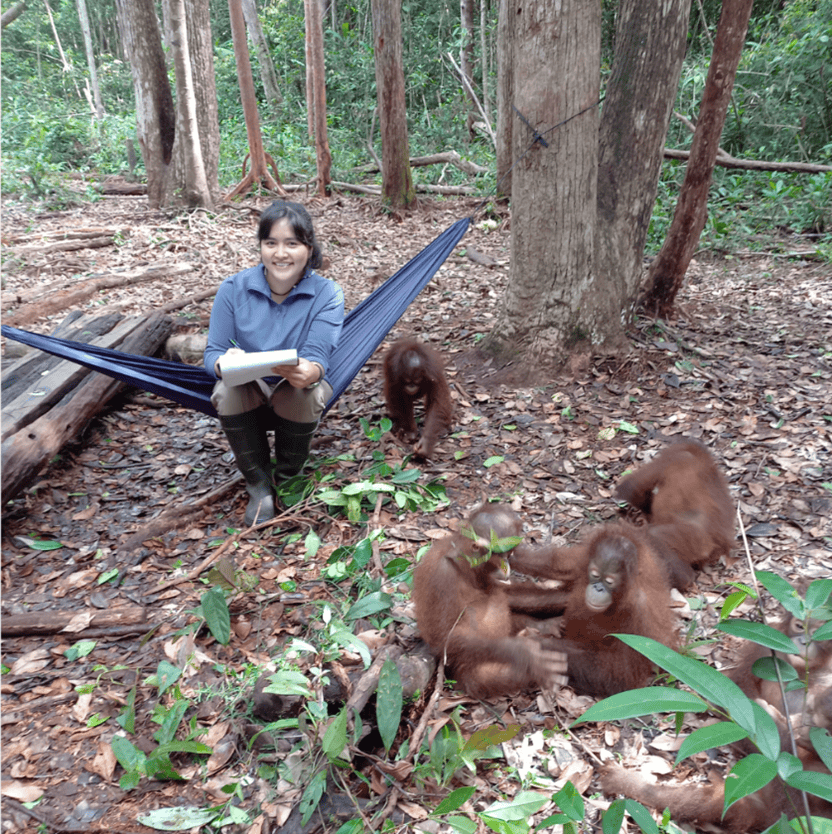 Dr Nadine Sugianto is an alumna of Kellogg College, where she completed her DPhil in Zoology in 2018 at the Wildlife Conservation Research Unit (WildCRU), researching the reproductive endocrinology and ecology of the European badger. She has a background in Veterinary Medicine and has long been motivated to return home to contribute to the conservation of Indonesia’s wildlife, particularly its primates.
In 2020, she began her role as a Postdoctoral Research Fellow at the University of Birmingham’s School of Biosciences, working on the Orangutan Enclosure Design Tool (EDT) Project, a collaboration with the Borneo Orangutan Survival Foundation (BOSF) in Central Kalimantan. The project aims to facilitate learning and better prepare orangutans in the rehabilitation centre to thrive in the wild by utilising long-term behavioural observations and targeted learning interventions, following individuals from the “Forest School” stage through the pre-release islands and ultimately to their release. After more than three years working closely with BOSF’s rehabilitation centre in Kalimantan, she was invited to lead the organisation’s newly established Research and Animal Welfare Division in 2024. In this role, she supports evidence-based decision-making across conservation activities, oversees research management and collaborations, as well as works to assess research needs and expand capacity within BOSF. Through her work, she aims to contribute to the conservation of orangutans and other endemic Indonesian species.
David is interested in the scientific underpinning of practical and policy solutions to problems in wildlife conservation. Although his background is in the behavioural ecology of mammals, his research spans taxa ranging from mammals to moths and is interdisciplinary, including collaboration with environmental economics and the social sciences. Much of his work is driven by conflict between people and wildlife, including predation, infectious disease and invasive species, with long-term studies on badgers, lions, mink and Ethiopian wolves. A unifying theme across his research is the ecological basis of social organisation, particularly the impacts of resource dispersion and perturbation. He has particular expertise in the Carnivora, with a current focus on Felidae, including research on Scottish wildcats, lions, tigers and leopards, as well as the effects of logging on Bornean felids and the role of human perceptions and attitudes towards pumas and jaguars.
Open to: Alumni, General Public, Oxford University members,